

Standard Artisan Cup: October 2026 Meta Breakdown
Explore all 25 decks from the October 2026 Standard Artisan Cup: Golgari Roots, Sultai Caves, Izzet Terror, and the sideboard cards shaping the field.
Analysis • Remmerio • 18 October 2026
Standard Artisan Cup — October 2026 Meta Breakdown
Twenty archetypes across 25 players, three Golgari Roots lists, and 53 Soul-Guide Lanterns: October's Standard Artisan Cup brings plenty of different ideas, with Midrange making up to 40% of the field and Control and Tempo / Spells each accounting for 16%.
Looking through the Standard Artisan Cup entries, it is hard to point to one deck the community has settled on: Golgari Roots leads with three players, Sultai Caves, Izzet Terror, and 5C Erthas Pizzeria have two each, while the remaining sixteen archetypes have a single representative.
That spread leaves plenty of room for different approaches, although it would be premature to take it as proof that the format is balanced. What we have is a snapshot of the decks players chose to bring, and reading the full lists gives us a better sense of their preparation, the cards they agree on, and the slots where their builds head in different directions.
The most striking number comes from the sideboards, because a tournament with twenty archetypes still contains 53 copies of Soul-Guide Lantern across the submitted lists. There is plenty of variety in how players want to win, and rather more agreement on what they want to keep out of the graveyard.
Standard Artisan Cup Metagame Breakdown
| Archetype | Players | Field share |
|---|---|---|
| Golgari Roots | 3 | 12% |
| Sultai Caves | 2 | 8% |
| Izzet Terror | 2 | 8% |
| 5C Erthas Pizzeria | 2 | 8% |
| Boros Weenie | 1 | 4% |
| Orzhov Combo | 1 | 4% |
| Mono-White Auras | 1 | 4% |
| Dimir Haunt | 1 | 4% |
| Jund Reanimator | 1 | 4% |
| Jeskai Tempo | 1 | 4% |
| Mono-Red Aggro | 1 | 4% |
| W-U-R-G Midrange | 1 | 4% |
| Jund Midrange | 1 | 4% |
| Selesnya Life Gain | 1 | 4% |
| Azorius Tempo | 1 | 4% |
| Golgari Elves | 1 | 4% |
| Mono-Black Discard | 1 | 4% |
| Izzet Combo | 1 | 4% |
| Simic Control | 1 | 4% |
| Mono-Red Burn | 1 | 4% |
| Total | 25 | 100% |
Midrange Leads with Ten of the Twenty-Five Decks
Midrange accounts for 40% of the field, followed by Aggro at 20%, Control and Tempo / Spells at 16% each, and Combo at 8%.
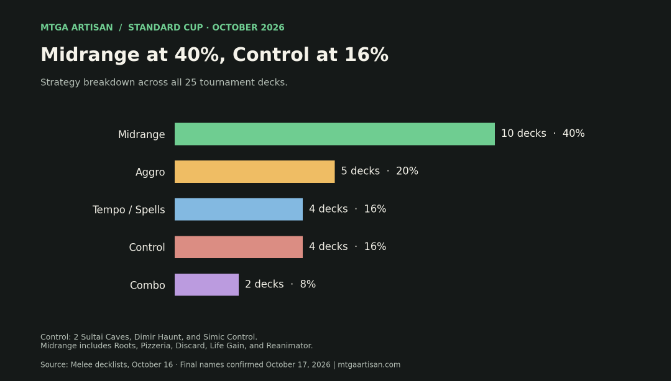
For this report, Caves decks and lists containing Haunt the Network are classified as Control. That group includes both Sultai Caves lists, Simic Control, and JekyllCloser's Dimir Haunt, which runs four Haunt the Network.
Our Midrange category includes Roots, Pizzeria, Discard, Life Gain, and Reanimator, making it a broad grouping that needs a little unpacking when we move from percentages to actual matches. Jund Reanimator, for instance, dedicates ten slots to Zombify, Live or Die, and Badlands Revival, with threats such as Pelakka Wurm and Altanak, the Thrice-Called to bring back; Roots uses the graveyard through a different engine, with different demands on its resources.
The breakdown helps us get our bearings, but preparing for a matchup means looking past that first label and understanding how each list plans to build its advantage.
Golgari Roots: Three Lists Built Around the Same Core
Lenz, Retribution1890, and icy_flurryrahul bring Roots to 12% of the field, with all three running four copies each of Insidious Roots, Molt Tender, and Rubblebelt Maverick, supported by varying numbers of Town Greeter, Eternal Student, and Something Worth Saving.
Lenz and Retribution1890 share 48 of their 60 main-deck cards, including lands, while icy_flurryrahul shares 44 with each of them and includes three Hollow Marauder and two Diamond Weapon among their choices.
The engine takes up a substantial part of each deck, but there is still enough room for the builds to behave differently when a game gets difficult. As we follow them, it will be worth watching which cards help rebuild after an opponent's answer, which break through a stalled board, and which find fewer useful windows than expected.
Three players will not give us a definitive answer on every slot, but they do give us a reason to look beyond the archetype's combined record and pay attention to the individual builds.
Sultai Caves: Six Slots Between Threats and Answers
Kombat and PierGigix share 54 of their 60 main-deck cards, including four Spelunking, four Gargantuan Leech, four Stock Up, and two Omega, Heartless Evolution, alongside Forgotten Monument and the Hidden land package.
Their entire main-deck difference comes down to these six slots:
| Kombat | PierGigix |
|---|---|
| 4 Desolation Prowler | 3 Malicious Eclipse |
| 2 Strategic Betrayal | 2 Requiting Hex |
| — | 1 Bandit's Talent |
Kombat keeps four Desolation Prowler, while PierGigix makes more room for answers through Malicious Eclipse and Requiting Hex, alongside a copy of Bandit's Talent.
It is a useful example of a familiar Control deckbuilding question: how many slots should go to threats, and how many should help you reach the stage of the game where those threats can matter? The five Aggro decks offer potential matchups where the more reactive package could earn its place, while other opponents might put a greater premium on having threats available.
Their pairings will provide much of the context, so we will need to consider the decks they face before giving those six slots too much credit or blame.
Dimir Haunt and Simic Control Round Out the Field
JekyllCloser's Dimir Haunt pairs four Haunt the Network with an extensive artifact package featuring Black Mage's Rod, Tithing Blade, Cryogen Relic, Grim Bauble, and Case of the Filched Falcon, supported by Fear of Isolation and Boomerang Basics.
Ismael Gomes's Simic Control takes a different approach, with four Countersculpt, four Flow State, and four Plan for All Outcomes, alongside Get Out and Spell Snare.
Together with the two Caves lists, these decks give Control four seats in the tournament, enough to make it a meaningful part of the field without presenting opponents with one uniform build to prepare for.
Izzet Terror: What the Name Means in Our Community
On our server, Terror refers to a family of strategies, following the community discussion about how to classify this game plan, so a list does not need to contain Tolarian Terror itself to belong to the archetype.
Alan Jones and rayandeveloper illustrate that distinction well: both run four Eddymurk Crab and four Hearth Elemental, but only rayandeveloper adds the full playset of Tolarian Terror.
| Card | Alan Jones | rayandeveloper |
|---|---|---|
| Eddymurk Crab | 4 | 4 |
| Hearth Elemental | 4 | 4 |
| Tolarian Terror | 0 | 4 |
| Countersculpt | 4 | 0 |
| Flow State | 4 | 0 |
| Way of the Pyromancer | 3 | 0 |
Alan makes room for Countersculpt, Flow State, and Way of the Pyromancer, supporting the plan of casting spells and reducing the cost of his threats through a different configuration.
The two lists share 38 main-deck cards, including lands, which explains why we can group them together without treating them as interchangeable when discussing their matches. The common name describes the strategy, while the individual slots show how each player has chosen to build it.
Five Aggro Decks Asking Different Questions
Mono-White Auras, Mono-Red Aggro, Mono-Red Burn, Boros Weenie, and Golgari Elves have one pilot each, spreading the aggressive 20% of the field across several distinct builds.
Clynch02's Mono-White Auras runs four copies each of Ethereal Armor, Sheltered by Ghosts, Feather of Flight, Shardmage's Rescue, and Lightwheel Enhancements, alongside Optimistic Scavenger and Slumbering Keepguard, committing a substantial part of the list to the interaction between creatures and enchantments.
Ramfred77 brings an artifact-heavy Mono-Red Aggro build featuring Goblin Tomb Raider, Clockwork Percussionist, HYDRA Assault Robot, Diamond Mare, and Hawkeye's Bow; CanaanAbel chooses Mono-Red Burn, putting considerable space into direct damage through Lightning Strike, Burst Lightning, and Boltwave, alongside Coruscation Mage and Death to Our Enemies.
For their opponents, surviving the opening turns therefore calls for different answers, because a card that handles a creature loaded with Auras may do very little against a sequence of spells aimed at their life total.
Aspar's Jeskai Tempo remains in the Tempo / Spells group, despite its strong aggressive token component through four Resolute Reinforcements, four Rally the Monastery, four Imodane's Recruiter, and four Balmor. It is one of the lists that reminds us how flexible these boundaries can be, particularly when a deck combines building a board with spells that turn that board into a much bigger attack.
Soul-Guide Lantern Is in Almost Everyone's Plans
Twenty of the twenty-five sideboards contain Soul-Guide Lantern, for a total of 52 copies, with another copy in the Golgari Elves main deck bringing the count to 53 across 21 players, or 84% of the field.
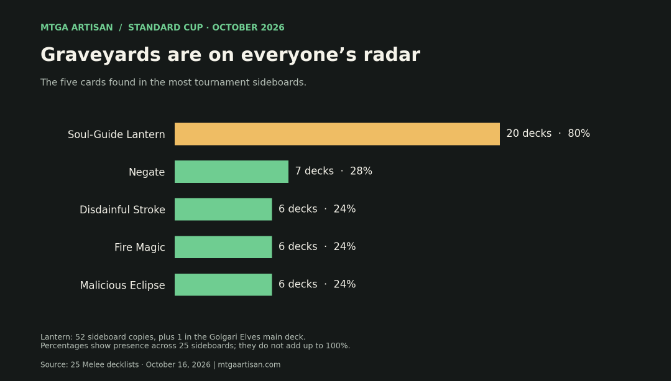
The chart counts sideboards containing each card, rather than total copies; Lantern's presence rises from 80% of sideboards to 84% of players when the main-deck copy is included.
The potential targets make this preparation worth watching: alongside the three Roots decks and Jund Reanimator, Orzhov Combo runs four Helping Hand and four Call a Surprise Witness, while Terror's threats also use the graveyard to reduce their costs.
The lists cannot tell us which opponent each player had in mind, or whether they were preparing for a particular archetype or covering several matchups with the same card. They do show a field where graveyard decks should expect to encounter dedicated interaction frequently after game one.
That puts Roots in an interesting position, as the most represented archetype enters a tournament where most opponents have access to a tool that attacks one of its important resources. Having Lantern somewhere in the 75 does not settle the matchup, because its pilot still needs to draw it, decide when to deploy it, and judge how long they can afford to wait before using it, while the Roots player looks for a way to draw out that response without giving up their entire development.
Those decisions are where the figure of 53 copies becomes more than a number in a metagame report.
The Main-Deck Cards Shared Across Archetypes
Excluding lands, Burst Lightning appears in the most main decks, with 23 copies spread across six players.
| Card | Decks | Main-deck copies |
|---|---|---|
| Burst Lightning | 6 | 23 |
| Bitter Triumph | 5 | 18 |
| Stock Up | 5 | 17 |
| Spell Snare | 5 | 13 |
| Sleight of Hand | 4 | 16 |
| Flow State | 4 | 14 |
| Way of the Pyromancer | 4 | 14 |
Way of the Pyromancer appears in Alan Jones's Izzet Terror, Izzet Combo, and both 5C Erthas Pizzeria lists, crossing three archetypes that remain separate in the deck breakdown.
The Pizzeria builds also share four copies each of Everything Pizza, Prismatic Undercurrents, Spider Manifestation, and Way of the Paradox, while Sonotone runs three Ertha Jo, Frontier Mentor and janissmiles runs four.
These overlaps give us another way to read the metagame beneath the deck names, showing which cards find homes in several builds and which packages remain closely tied to a particular strategy.
What We Will Be Watching During the Cup
The three Roots builds, the six slots separating the Sultai Caves lists, and the different Terror configurations give us concrete comparisons to follow, alongside Dimir Haunt and five Aggro decks testing different parts of their opponents' defenses.
With so many archetypes represented by a single player, pairings will matter when we look back at each run, and we should be careful about turning one list's result into a verdict on the whole strategy. The numbers will be more useful alongside the details players bring back from their matches: a sideboard choice that solved a specific problem, a card that spent too much time stranded in hand, or a Lantern that forced both players to rethink their sequencing.
If you are playing in the Cup, tell us on Discord which choices in your list have earned their slots and which you would change after the opening rounds, because those observations are a big part of what makes brewing and comparing decks in this community worthwhile.